Are you ready to advance your behavioral research? We are especially proud that FaceReader 10 has just been released. With the 10th edition of our industry-leading software, we go beyond facial expression analysis to provide a comprehensive multimodal behavioral analysis solution. This release reflects years of continuous innovation, feedback from a global user base, and our commitment to advancing behavioral science. Read more to find out what’s new in FaceReader 10.
New features: webcam eye tracking
FaceReader 10 now offers an Advanced Research Module with eye tracking and the ability to analyze multiple subjects simultaneously – both frequently requested by the FaceReader community. We have been developing webcam eye tracking for some while now (it is already available in FaceReader Online). This technology allows gaze tracking assessment with a simple webcam (instead of requiring specialized eye-tracking hardware). The stimulus presentation tool performs a calibration test for the participant, to match gaze estimation with a point on the screen. This can create numerical data or a heatmap. Our validation study indicated an accuracy of 96% when classifying whether the gaze was in an area that is 1/16 of the screen. If you need exact pixel-level precision, hardware-based eye-trackers are your best bet; but for a wider range of applications where you want to know what in a video captures someone’s attention, this is more than enough.
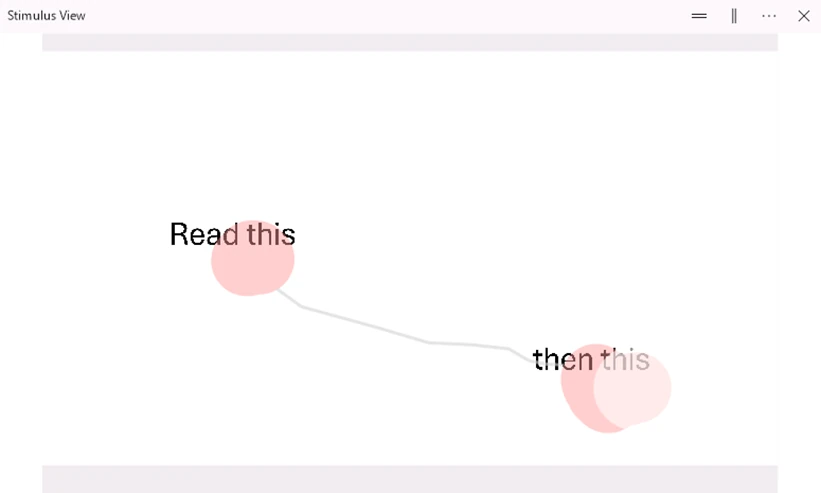
Fixation and saccade visualization of one participant.
New feature: multi-subject analysis
Researchers studying human interactions will be happy that they can easily import multiple participants from a single video stream. This is especially valuable for studying social interactions. FaceReader 10 allows for up to 8 participants from one video, making it easy to analyse, for example, a panel interview via Zoom. The new functionality enables additional options in the project analysis window that focus on individual participant visualisations. This will make research more efficient since important analysis steps can be performed directly in FaceReader. This also benefits single participant tests. You can easily visualize metrics (e.g., mean or max value) of all participants in one graph. This makes it easy to see the distribution of expressions in your sample.
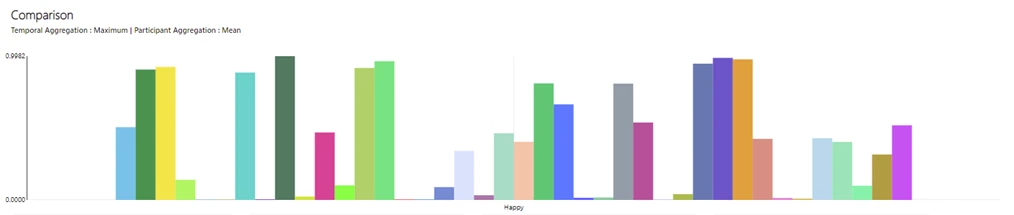
Example of the maximum value of the happy expression for 50 participants in 1 graph.
Multimodal analysis: emotion from speech and breathing rate
Another bold innovation: facial expressions are only one behavioral output of emotional experience; another important one is speech. In FaceReader 10, we’ve introduced voice AI algorithms that can perform state-of-the-art speech emotion recognition. We can now classify happy, anger, and sad expressions from speech, in addition to valence and arousal (based on speech rate and loudness).
If you are interested in more subtle signals, the vital signs module has now been updated with breathing rate. This is based on very subtle movements in the body. The models are state of the art and can estimate breathing rate with a deviation of around 1 breath per minute under good conditions. It has the benefit that the participant does not have to wear any sensors on the body.
These insights can give a complete picture of the behavior of the participant, all in one tool that can run on a research laptop. It has never been easier to create an advanced research lab.
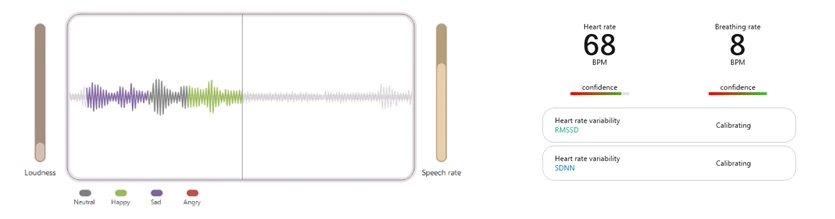
Emotion from speech and vital signs analysis visualization.
Last but not least: better user interface and custom expression repository
With all these innovations, we also took time to update the user interface, making everything run more smoothly and user-friendly. For example, you can split the analysis window into multiple windows, allowing versatile visualization.
Another way we facilitate FaceReader’s users: the custom expression module is now connected to an online repository. This means FaceReader 10 comes with a set of examples (e.g., additional AUs, complex expressions, behavioral states). Now, if there is an update, you don’t have to wait for a new FR release, since the custom expressions are updated immediately. Do you want to request a certain expression, or have you created one that you would like to share? Let us know!

The custom expressions repository.
How to start advancing your research with FaceReader 10
Whether you’re working in psychology, neuroscience, marketing, or human-computer interaction. Whether you’re studying synchrony in parent-child interactions, exploring website usability with eye-tracking, or doing voice analysis in social interactions. FaceReader 10 equips you with the most advanced tools yet to analyze human behavior. If you want to know more about one of the technologies, request one of the white papers for an in-depth description. Contact Noldus to receive a FaceReader 10 trial now.